
Professional train freight service
Compare rail freight rates, transit times and corridors from China to Europe. See where train freight beats sea and air before you book.
Fast Response
Secure & Reliable
China to worldwide
Quote within 30 minutes
Quick Answer: Train Freight Cost, Transit Time & Quote
Is Train Freight the Right Choice for Your Shipment?
🚆 When Train Freight Makes Sense
The middle ground · Balanced cost and speed
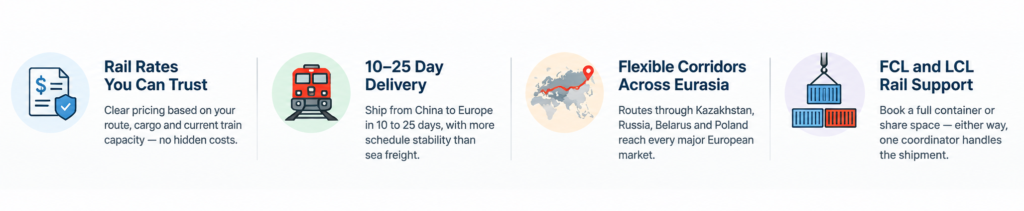
- Use rail if: Sea freight is too slow and air freight costs too much for your timeline.
- Best for: China to Europe, Russia and UK shipments needing predictable delivery without air freight pricing.
- Typical transit: 10–25 days depending on destination and corridor.
- Good fit for: Importers, e-commerce sellers, and businesses shipping regular volume that doesn’t justify air freight.
💵 Train Freight Cost From China
Container rates · Route-dependent
- Estimated cost: Roughly $1,500–$5,500 per 20ft container.
- Lower cost: Russia and Eastern Europe — shorter rail segments, simpler border handling.
- Higher cost: Western and Southern Europe — longer distance, more transit hubs.
- Choose this if: You want a route-based number before committing to a shipment plan.
📋 What Moves Your Final Price
Route · Weight · Volume · Capacity
- Cargo factors: Weight, CBM, carton dimensions, and FCL vs LCL choice.
- Route factors: Which corridor and how many border crossings your destination requires.
- Market factors: Train capacity, seasonal demand, and customs conditions at each border.
- Choose this if: Your destination or volume could shift between quote ranges.
✅ How to Get a Tighter Rail Quote
Send details once, avoid re-quoting
- Send us: Pickup city, destination country, cargo type, weight, CBM and carton size.
- Confirm: Whether you need FCL, LCL, terminal delivery, or full door-to-door.
- Cut cost: Book ahead of peak demand, optimise packing, and combine smaller shipments where possible.
- Choose this if: You want the right route and service type matched to your cargo, not a generic estimate.
Need a rail freight quote from China? Send your cargo details and we’ll check the best route and rate.
Introduction
Sea freight to Europe can take six weeks. Air freight gets there in days but at a price that erases margin on anything but the highest-value cargo. Train freight sits in the gap between them, and for China-to-Europe shipments specifically, it’s often the option importers don’t know to ask about.
The China–Europe rail network has matured into a genuine third option — not a niche service, but a scheduled, containerised system running through established corridors with predictable transit windows.
This guide covers real rail freight cost ranges, transit times by destination, the corridors that actually move the cargo, and how rail stacks up against sea and air for a shipment that doesn’t fit cleanly into either.
QCYT arranges FCL and LCL train freight from major Chinese rail hubs, with door-to-door delivery available across most European destinations.
Table of Contents
- You might also need these services!


DDP Shipping from China

Express courier from China
Train Freight Cost From China (Estimates)
Rail freight cost from China typically runs $1,500 to $5,500 per 20ft container, sitting between the lower cost of ocean freight and the higher cost of air freight.
What Affects Rail Freight Cost
- Destination country – distance and number of border crossings.
- Service type – FCL (full container) or LCL (shared).
- Cargo type – general cargo prices differently from restricted or oversized goods.
- Rail corridor chosen – different routes carry different cost structures.
- Seasonal demand and train capacity – space tightens at certain points in the year, pushing rates up.
Rail Freight Rate Estimates (20ft Container)
|
Destination |
Estimated Cost (USD) |
Notes |
|
Russia |
$1,500–$3,500 |
Shortest rail segment, direct access |
|
Poland |
$2,800–$4,200 |
Main EU entry point for rail freight |
|
Germany |
$3,000–$4,500 |
Major logistics hub, stable demand |
|
Netherlands |
$3,200–$4,800 |
Often routed via Germany |
|
Belgium |
$3,200–$4,800 |
Strong onward distribution network |
|
France |
$3,500–$5,000 |
Western Europe delivery |
|
Italy |
$3,800–$5,500 |
Longer route, higher transit cost |
These are planning ranges, not live quotes — confirm current pricing before booking, since rail rates move with fuel cost, capacity and seasonal demand like every other freight mode.
Worth noting: cost doesn’t scale purely with distance. A shipment routed through a well-established hub like Poland or Germany often benefits from more stable scheduling and more competitive pricing than a similar-distance shipment on a less-used corridor. The corridor matters as much as the mileage.
If your cargo doesn't fill a container, ask specifically for an LCL rail quote rather than assuming FCL is your only option rail LCL is well established on the main China–Europe corridors and can bring costs down significantly for partial loads.
💡 PRO TIP
How Long Does Train Freight Take From China?
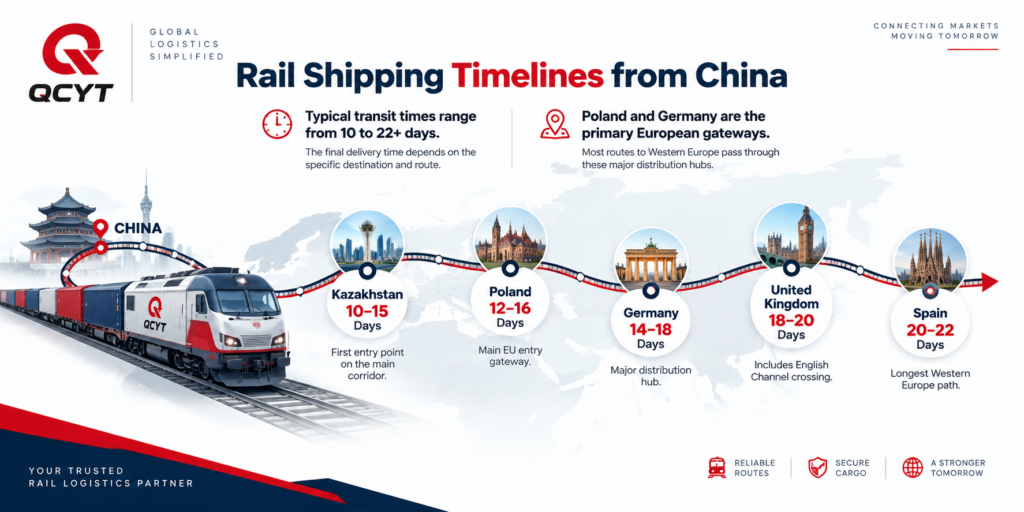
Rail transit time from China depends on the destination, the corridor used, and — more than either of those — customs processing at the borders the train crosses.
Transit Times by Destination
|
Destination |
Transit Time |
Route Role |
|
Kazakhstan |
10–15 days |
First major entry corridor from China |
|
Russia |
10–16 days |
Longest single rail segment |
|
Poland |
12–16 days |
Main EU gateway |
|
Belgium |
12–14 days |
Connected via Poland/Germany |
|
Belarus |
14–16 days |
Key customs transition point |
|
Netherlands |
14–16 days |
Final distribution, routed via Germany |
|
Lithuania |
14–16 days |
Baltic route via Belarus/Poland |
|
France |
14–17 days |
Western Europe delivery |
|
Latvia |
14–17 days |
Northeastern Baltic corridor |
|
Germany |
14–18 days |
Central distribution hub |
|
Iran |
12–18 days |
Middle corridor, variable conditions |
|
Czech Republic |
15–18 days |
Central European distribution |
|
United Kingdom |
18–20 days |
Includes Channel crossing |
|
Italy |
18–22 days |
Extended southern corridor |
|
Spain |
20–22 days |
Longest western route |
Why Border Crossings Matter More Than Distance
The single biggest factor in rail transit variance isn’t how far the train travels — it’s how many borders it crosses and how each one processes customs. A shipment can sit at a border transition point for longer than it spends moving between two of them.
This is why two destinations at similar distances from China can have noticeably different transit windows: the number of customs handoffs along the route matters more than raw kilometres.
The quoted transit time usually covers the main rail journey only. Pickup at origin and final delivery at destination can each add a few extra days build that into your planning rather than treating the rail transit figure as door-to-door.
💡 PRO TIP
Major Train Freight Routes From China
Rail freight from China to Europe runs on a handful of established corridors. Which one your shipment uses depends on the destination, customs requirements and current schedule availability.
|
Route |
Coverage |
Typical Use |
Key Advantage |
|
Northern Corridor (Trans-Siberian) |
China → Mongolia → Russia → Belarus → Poland → Germany |
Russia and Eastern Europe |
Direct access through Russia |
|
Middle Corridor (New Eurasian Land Bridge) |
China → Kazakhstan → Russia → Belarus → Poland → Germany |
Germany, Poland, general EU cargo |
Balanced cost and transit time |
|
Southern Corridor (Central Asia–Caucasus) |
China → Kazakhstan → Azerbaijan → Georgia → Turkey → Europe |
Southern Europe and Turkey |
Alternative to the northern routes |
|
China–Russia Direct |
China → Russia (Moscow and beyond) |
Russia-only shipments |
Simplified single-country routing |
|
Yiwu–Europe Railway |
Yiwu → Kazakhstan → Russia → Belarus → Poland → EU |
Multi-destination EU shipping |
Wide European coverage |
|
Chongqing/Chengdu/Xi’an Routes |
Major inland hubs → Kazakhstan → Russia → Belarus → EU |
Flexible origin-based shipping |
Multiple origin options across China |
The fastest route on paper isn’t always the fastest in practice — a shorter corridor with more border handoffs can take longer than a marginally longer one that crosses fewer customs zones. QCYT selects the corridor based on your actual destination and current network conditions, not a single default route.
This is why two destinations at similar distances from China can have noticeably different transit windows: the number of customs handoffs along the route matters more than raw kilometres.
Train Freight vs Sea Freight vs Air Freight
|
Mode |
Typical Cost |
Transit Time |
Best For |
|
Sea Freight |
Lowest |
25–45 days |
Large volume, non-urgent cargo where cost is the priority |
|
Rail Freight |
Moderate |
10–25 days |
China–Europe shipments needing balanced cost and speed |
|
Air Freight |
Highest |
3–7 days |
Time-critical or high-value cargo |
Rail freight exists precisely for the shipment that doesn’t fit cleanly into either extreme — too time-sensitive for a six-week sea transit, but not valuable enough per kilo to justify air freight’s cost. For most China–Europe cargo in this middle zone, rail is worth pricing before defaulting to either alternative.
This is why two destinations at similar distances from China can have noticeably different transit windows: the number of customs handoffs along the route matters more than raw kilometres.
Why Train Freight From China Works Well for Europe Shipments
China’s rail network connects major export hubs — Chongqing, Chengdu, Xi’an, Wuhan, Zhengzhou, Yiwu, Guangzhou, Shanghai and Tianjin — to destinations across Europe, Russia, Central Asia and parts of the Middle East.
Key advantages:
- Faster than sea freight — roughly half the transit time on most China–Europe lanes.
- Lower cost than air freight — typically a fraction of the per-kilo air rate.
- More predictable scheduling — trains run on fixed timetables rather than variable vessel or flight capacity.
- FCL and LCL both supported — full containers for large volume, shared space for smaller shipments.
Rail tends to be the right call when your shipment:
- Needs faster delivery than sea freight can offer.
- Doesn’t justify the cost premium of air shipping.
- Benefits from a stable, scheduled transit window rather than one subject to port congestion or airline capacity swings.
Why Choose QCYT for Train Freight?
Route Selection Based on Your Destination
Rather than defaulting to one corridor for every shipment, QCYT selects the route that balances transit time and cost for your specific destination — Russia, Poland and Germany often favour different corridors than Southern Europe.
FCL and LCL Under One Service
Whether your cargo fills a container or needs shared space, the same coordinator handles booking, documentation and tracking from pickup to delivery.
Full Customs Support at Every Border
Since most delays happen at border crossings rather than during the rail journey itself, documentation is checked and prepared before departure to reduce the risk of a hold at any single transition point.
Door-to-Door or Terminal Delivery
Rail freight can be arranged as a fully managed door-to-door service — pickup from your supplier, export handling, rail transport, customs clearance, and final delivery — or as terminal delivery if you handle the last leg yourself.
Your Questions Answered
What is train freight from China?
An international shipping method that moves cargo from Chinese suppliers to Europe, Russia and nearby regions using cross-border rail networks. It typically includes pickup from the supplier, export documentation, rail transport, customs clearance at borders and destination, and final delivery.
How long does train freight from China to Europe take?
Generally 10–25 days, depending on destination, rail corridor and customs processing. Russia and Poland tend to be faster; Southern Europe and the UK take longer.
How much does train freight from China cost?
Roughly $1,500–$5,500 per 20ft container, depending on destination, service type (FCL or LCL), cargo volume and current train capacity.
Is train freight cheaper than air freight?
Yes, substantially. Rail freight offers a meaningful cost reduction compared to air, while still delivering faster than sea freight which is exactly the gap it’s designed to fill.
Does train freight support LCL shipments from China?
Yes. LCL rail freight is well established on the main China–Europe corridors, letting smaller shipments share container space rather than requiring a full container booking.
What countries can be reached by train freight from China?
Common destinations include Germany, Poland, the Netherlands, Belgium, France, Spain, Italy, the UK, Russia, Kazakhstan and Iran.
Which rail route from China is most reliable?
The Northern Corridor and Middle Corridor are generally the most established, with more consistent scheduling and infrastructure. The best route for your specific shipment still depends on destination and current network conditions.
What factors affect train freight transit time?
Route and corridor selection, the number of border crossings and customs processing at each one, cargo type, and rail network scheduling or congestion — distance alone is a weaker predictor than these factors.
Can train freight be delivered door to door?
Yes. A door-to-door rail service can include supplier pickup, export handling, rail transport, customs clearance and final delivery, all managed as one process.
How do I book train freight from China?
Send your cargo type, weight or volume (CBM), pickup city and destination. QCYT handles supplier pickup, export documentation, rail booking, customs processing and final delivery from there.