
DDU Freight Service From China
Door-to-door delivery from China with freight, export handling and transport managed for you duty and tax paid separately by you at destination.
Fast Response
Secure & Reliable
China to worldwide
Quote within 30 minutes
Quick Answer: What Is DDU Freight and What Does It Cost?
Is DDU Freight the Right Choice for Your Shipment?
📦 When DDU Makes Sense
You handle duty · We handle everything else
- Use DDU if: You want the freight forwarder to manage transport and delivery, but you’ll pay duty and tax yourself at destination.
- Best for: Importers who already know their product’s duty classification, have an existing customs relationship, or want full visibility into what they’re paying customs directly.
- Typical timing: Air DDU 3–7 days; sea DDU 25–55 days — the same as standard freight transit, since DDU doesn’t add customs processing to the forwarder’s side.
- Choose this if: You’d rather pay duty directly to your government than have it bundled into a forwarder’s markup.
💵 DDU Freight Cost
Freight and handling only — duty billed separately
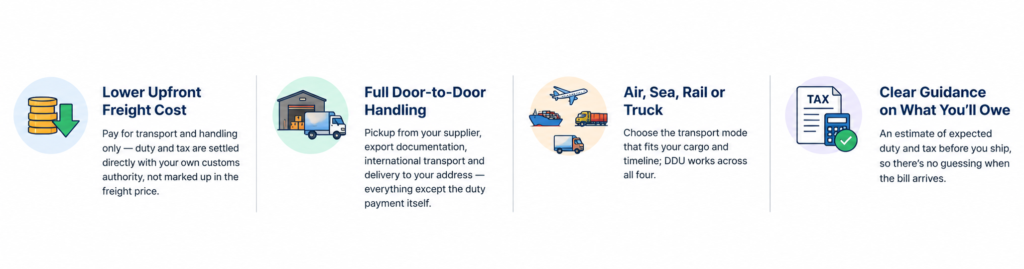
- What’s included: Pickup, export handling, international transport, and delivery to your address.
- What’s not included: Import duty, VAT/GST, and any customs brokerage fee charged locally at destination.
- Typical saving vs DDP: DDU quotes usually come in below the equivalent DDP price, since no duty markup is built in.
- Choose this if: You want the lowest possible upfront freight number and are prepared to handle the duty payment yourself.
📋 What Moves Your Final Quote
Weight · Mode · Destination · Your duty exposure
- Cargo factors: Weight, volume, product type and chosen transport mode (air, sea, rail, truck).
- Route factors: Pickup city, destination country, and delivery address type.
- Your side: Estimated duty rate and any local brokerage fee — QCYT can estimate this, but the actual payment is yours to make.
- Choose this if: You want a freight-only number, and you’ll handle the customs side with your own broker or knowledge.
✅ How to Get a Cleaner DDU Quote
Avoid surprises at delivery
- Send us: Product name, HS code if known, pickup city, destination address, weight or CBM, and preferred transport mode.
- Ask for: An estimated duty and tax figure alongside your freight quote, even though QCYT won’t collect it.
- Reduce total landed cost: Confirm your product’s correct HS code before shipping — a wrong code can mean paying more duty than necessary, or a customs hold.
- Choose this if: You want the freight rate and a realistic sense of your total landed cost side by side.
Considering DDU freight? Send your cargo details and we’ll quote the freight and estimate what you can expect to pay at customs.
Introduction
Every DDP quote has duty baked into the number somewhere. That’s convenient, but it also means you’re paying the forwarder’s estimate of your duty rate — and forwarders build in a margin for the risk of getting that estimate wrong.
DDU strips that layer out. The forwarder still does everything up to your border — pickup, export paperwork, freight booking, transport, arrival at destination — but stops short of paying duty and tax on your behalf. You settle that directly with customs, or through your own broker, using the actual rate that applies to your product.
For an importer who already knows their HS code and duty rate, or who simply wants to see the real number rather than a forwarder’s estimate, that can mean a lower total cost and more transparency. For a first-time importer navigating an unfamiliar customs system alone, it can mean unexpected delays or an invoice that lands weeks after the goods do.
This guide explains exactly what DDU includes, how it compares to DDP, what it costs by transport mode, and how to decide which one actually fits your situation.
QCYT arranges DDU freight from every major Chinese hub, across air, sea, rail and road.
This matters most for sellers shipping to markets that sea freight reaches slowly and expensively — Central Asia, Russia, and inland Europe, where the final leg from a seaport can add as much time as the ocean crossing itself.
This guide covers real FTL and LTL cost ranges, transit times by destination, the trucking corridors that actually move freight out of China, and how to decide between a full truck and shared space.
QCYT arranges road freight service from major manufacturing hubs across China, with FTL and LTL options and door-to-door delivery available on most routes.
Table of Contents
- You might also need these services!


DDP Shipping from China

Express courier from China
What Is DDU Freight From China?
DDU stands for Delivered Duty Unpaid. It’s an older Incoterm, largely superseded in official trade terminology by DAP (Delivered at Place), but the phrase “DDU” is still widely used in freight forwarding to describe the same practical arrangement: everything delivered to your door, except duty and tax.
In practice, DDU freight means:
- QCYT arranges pickup from your supplier in China.
- Export documentation and customs clearance in China are handled as part of the service.
- International transport (air, sea, rail or truck) is booked and managed.
- The shipment is delivered to your address, warehouse or fulfilment centre.
- You — or your customs broker — handle import clearance, pay duty and tax, and settle any local brokerage fee.
DDU tends to suit importers who:
- Already have an established customs broker relationship in their destination country.
- Know their product’s HS code and duty rate well enough to budget accurately.
- Want to see the actual duty invoice from their own government, rather than a forwarder’s built-in estimate.
- Are importing a product category that some forwarders won’t cover under DDP due to regulatory restrictions.
DDU isn't automatically cheaper once you account for everything — it shifts the duty payment to you and removes the forwarder's markup on that portion. Whether that's actually cheaper depends on whether you can get a better duty and brokerage outcome managing it yourself than the forwarder's bundled rate would have given you.
💡 PRO TIP
DDU vs DDP: What's the Real Difference?
This is the question most people searching “DDU freight” are actually trying to answer, so it’s worth being direct about it.
Factor | DDU (Delivered Duty Unpaid) | DDP (Delivered Duty Paid) |
Who pays duty & tax | You, at destination | Included in the forwarder’s quote |
Upfront freight cost | Lower — freight and handling only | Higher — duty and tax bundled in |
Predictability | You need to know or estimate your duty rate | One number, no separate invoice later |
Customs paperwork | Forwarder handles export side; you or your broker handle import clearance | Forwarder handles both export and import clearance |
Best for | Importers with duty knowledge or an existing broker | First-time importers wanting one predictable price |
Risk if duty is misjudged | Falls on you — you pay whatever customs assesses | Falls on the forwarder — your price was fixed upfront |
Speed | Same transit time as equivalent freight-only service | Same transit time; clearance is handled in parallel |
The short version: DDP trades a small premium for predictability and zero customs involvement on your part. DDU trades that premium away in exchange for you handling and potentially controlling more precisely the duty and tax side yourself.
Neither is universally better. The right choice depends on how confident you are in your own duty estimate and whether you already have a customs relationship at destination.
This is the right choice for large volumes, high-value goods, or anything that benefits from minimal handling furniture, machinery, palletised electronics, or fragile items that shouldn’t be reloaded partway through the journey.
DDU Freight Cost From China (Estimates)
Because DDU excludes duty and tax, the freight component of a DDU quote tracks closely with standard air or sea freight rates, plus export/import documentation handling. Duty and tax are additional and paid separately by you.
DDU Air Freight Cost From China (Per KG, Freight Only)
Destination Region | Example Countries | Estimated Freight Cost |
Asia | Japan, South Korea, Vietnam, Thailand, Malaysia | $5–10/kg |
Middle East | UAE, Saudi Arabia, Qatar, Kuwait | $6–12/kg |
Europe | Germany, UK, France, Netherlands | $6–13/kg |
North America | USA, Canada, Mexico | $7–16/kg |
Oceania | Australia, New Zealand, Fiji | $6–13/kg |
DDU Sea Freight Cost From China (Per CBM, Freight Only)
Destination Region | Example Countries | Estimated Freight Cost |
Asia | Japan, South Korea, Vietnam, Thailand | $60–100/CBM |
Middle East | UAE, Saudi Arabia, Qatar, Kuwait | $70–120/CBM |
Europe | Germany, UK, France, Netherlands | $80–140/CBM |
North America | USA, Canada, Mexico | $100–170/CBM |
Oceania | Australia, New Zealand, Fiji | $80–140/CBM |
On top of these figures, budget separately for: import duty (varies by HS code and destination), VAT or GST where applicable, and any local customs brokerage fee if you’re not clearing the shipment yourself.
These freight ranges are planning estimates, not live quotes confirm with a specific quote before committing to an order, since rates move with carrier capacity and season like any freight mode.
Before choosing DDU, ask QCYT for an estimated duty figure based on your product's HS code, even though you'll be the one paying it. Comparing "DDU freight + estimated duty" against a DDP quote for the same shipment is the only fair way to see which option actually costs less for you.
💡 PRO TIP
How the DDU Freight Process Works
Step 1 — Pickup from your supplier. QCYT collects the goods from the factory or warehouse in China.
Step 2 — Export documentation. Commercial invoice, packing list and export declaration are prepared and checked in China.
Step 3 — International transport. Your cargo moves by air, sea, rail or truck, depending on the service booked.
Step 4 — Arrival at destination. The shipment reaches the destination airport, seaport, rail terminal or border point.
Step 5 — Import clearance (your responsibility). You, or a customs broker you arrange, submit the import declaration and pay applicable duty and tax directly to your customs authority.
Step 6 — Final delivery. Once cleared, the shipment is delivered to your address, warehouse or fulfilment centre.
The key difference from DDP sits entirely in Step 5 everything else in the process is handled the same way.
What You Need Ready for Import Clearance Under DDU
Since you (or your broker) handle the import side, having these ready before the shipment arrives avoids delays at your border:
- Commercial invoice and packing list — provided by QCYT as part of export documentation, but you’ll need copies for import clearance.
- HS code for your product — get this confirmed before shipping, not after arrival. An incorrect code can mean paying the wrong duty rate or triggering a customs query.
- Import licence or registration, if your country requires one for your product category.
- A customs broker, if you don’t plan to file the import declaration yourself. Many countries allow self-clearance for straightforward commercial shipments, but a broker is often faster for anyone unfamiliar with the process.
- Funds ready for duty and tax payment — this is typically due at or shortly after clearance, not weeks later, so have it budgeted rather than treated as an afterthought
When DDU Makes Sense — and When DDP Is the Safer Bet
Being direct about this upfront saves you a bad experience later.
DDU tends to work well when:
- You already have a customs broker at your destination and a working relationship with them.
- You know your product’s duty rate accurately, or the rate is low and stable.
- You want the lowest possible upfront freight number and are comfortable managing the rest.
- You’re shipping regularly enough that handling import clearance yourself becomes routine rather than a one-off hassle.
DDP is usually the safer choice when:
- This is your first import shipment and you don’t yet have a broker relationship.
- Your destination country’s duty rules are complex, unfamiliar, or subject to frequent change.
- You want one predictable number for cash-flow planning, with no separate invoice arriving later.
- Your product falls into a category where getting the HS code or duty calculation wrong carries real financial risk.
QCYT can quote both options side by side for the same shipment so you can compare the actual numbers rather than guessing which structure suits you.
Why Choose QCYT for DDU Freight?
Freight Handled Fully, Customs Kept Transparent
Everything up to your border pickup, export documentation, transport, arrival is managed the same way as any other QCYT service. What changes under DDU is that duty stays visible and separate, not folded into a single number.
Duty Estimates Provided Upfront
Even though QCYT doesn’t collect duty under DDU, an estimated figure based on your product’s HS code is provided at quote stage, so you’re not left guessing what to budget.
All Transport Modes Available
DDU is offered across air, sea, rail and road, matched to your cargo weight, urgency and destination the same range of options as DDP.
Straightforward Switch to DDP If You Change Your Mind
If, after seeing the numbers, DDP looks like the better fit for your shipment, switching before booking is straightforward QCYT can requote the same cargo under either structure.
Your Questions Answered
What does DDU mean in freight shipping?
DDU stands for Delivered Duty Unpaid. The freight forwarder handles pickup, export documentation, international transport and delivery to your address, but you pay import duty and tax directly to customs at destination.
What is the difference between DDU and DDP?
DDP includes duty and tax in one upfront price; DDU excludes them, so you pay customs directly when the shipment clears. DDU freight quotes are typically lower upfront because they don’t carry a duty markup.
Is DDU cheaper than DDP?
Often, yes, on the freight component but you still owe duty and tax separately. Whether total landed cost is lower depends on whether you can achieve a better duty and brokerage outcome managing it yourself than a bundled DDP rate would offer.
How long does DDU freight take from China?
The same as standard freight for the chosen mode roughly 3–7 days by air and 25–55 days by sea since DDU doesn’t add customs processing time on the forwarder’s side.
Who pays customs duty under DDU?
You, the buyer, either directly to your customs authority or through a broker you arrange at destination.
Do I need a customs broker for DDU shipments?
Not always many countries allow self-clearance for straightforward commercial shipments. A broker is often worth using if you’re unfamiliar with the import process or your product requires specific certificates or licences.
Can QCYT tell me how much duty I'll owe under DDU?
Yes, an estimate based on your product’s HS code and destination is provided at quote stage, even though QCYT doesn’t collect the payment under a DDU arrangement.
Which is better for a first-time importer, DDU or DDP?
DDP is usually the safer starting point for a first-time importer, since it removes customs clearance and duty payment from your side entirely. DDU tends to suit importers who already have a broker relationship or solid duty knowledge.
Can I switch from DDU to DDP for the same shipment?
Yes QCYT can quote the same cargo under either structure before booking, so you can compare the numbers and choose.
Does DDU work for all transport modes?
Yes. DDU is available across air, sea, rail and road freight, matched to your cargo and timeline the same way DDP is.