
Professional truck freight service
Compare truck freight costs from China to Europe, Russia and Central Asia, choose between FTL and LTL, and see realistic transit times before you book.
Fast Response
Secure & Reliable
China to worldwide
Quote within 30 minutes

Quick Answer: Road Freight Cost, Transit Time & Quote
Is Road Freight the Right Choice for Your Shipment?
🚚 When Road Freight Makes Sense
Middle ground · Faster than sea, cheaper than air
- Use this if: You need delivery faster than ocean freight but at a lower cost than air.
- Best routes: Europe, Russia, Kazakhstan, Kyrgyzstan, Uzbekistan and nearby Central Asian markets.
- Typical transit: 3–28 days depending on destination and corridor.
- Good fit for: Heavy, oversized, commercial or moderately time-sensitive cargo.
💵 Road Freight Cost From China
FTL by destination · LTL for small loads
- FTL estimate: Roughly $1,000–$9,500 depending on distance and country.
- Lower cost: Central Asian routes — Kazakhstan, Kyrgyzstan, Uzbekistan.
- Higher cost: Western Europe, due to distance and extra border handling.
- Choose this if: You want a route-based number instead of a flat rate card.
📋 What Moves Your Final Quote
Route · Weight · Volume · Border conditions
- Shipment factors: Total weight, volume, carton size, and FTL vs LTL choice.
- Route factors: Which corridor your destination sits on and how many borders it crosses.
- Market factors: Fuel prices, seasonal demand and border processing times.
- Choose this if: Your cargo size or destination could shift the total price.
✅ How to Get a Tighter Quote
Send the details once, avoid re-quoting
- Send us: Pickup city, destination country and address, product type, gross weight, carton dimensions and total volume.
- Helpful extras: Preferred delivery timeline, whether the cargo is fragile or high-value.
- Cut cost: Book ahead of peak demand, optimise carton size, and use LTL if your load doesn’t fill a truck.
- Choose this if: You want the right FTL/LTL recommendation, not just a number.
Need road freight from China? Send your cargo details and get the right route and rate.
Introduction
Road freight sits in a gap that both sea and air freight leave open. Ocean freight to Europe can take six weeks. Air freight is fast but often costs three to five times more per kilo. For a shipment that needs to move in two or three weeks without an air freight bill, trucking is often the only sensible answer.
This matters most for sellers shipping to markets that sea freight reaches slowly and expensively — Central Asia, Russia, and inland Europe, where the final leg from a seaport can add as much time as the ocean crossing itself.
This guide covers real FTL and LTL cost ranges, transit times by destination, the trucking corridors that actually move freight out of China, and how to decide between a full truck and shared space.
QCYT arranges road freight service from major manufacturing hubs across China, with FTL and LTL options and door-to-door delivery available on most routes.
Table of Contents
- You might also need these services!


DDP Shipping from China

Express courier from China
Road Freight Cost From China (Estimates)
Trucking cost depends on three things above everything else: whether you book FTL or LTL, how far the destination is, and how much your shipment weighs and measures. Shorter routes and smaller loads cost less; long-haul Western European routes and full trucks cost more.
FTL Road Freight Costs From China
Country | Estimated Cost (USD) |
Kyrgyzstan | $1,000–$2,200 |
Kazakhstan | $1,200–$2,500 |
Uzbekistan | $1,800–$3,200 |
Russia | $3,500–$6,000 |
Poland | $5,000–$7,500 |
Germany | $5,500–$8,500 |
Belgium | $6,000–$8,800 |
Netherlands | $6,000–$8,800 |
France | $6,500–$9,000 |
Italy | $6,800–$9,500 |
These figures are planning ranges, not fixed quotes. Actual pricing shifts with fuel cost, seasonal border demand, and available truck capacity on a given corridor — always confirm with a live quote before committing to a purchase order.
The pattern is straightforward: Central Asia is cheaper because the distance is shorter and the corridors involve fewer border crossings. Western Europe costs more because the truck crosses several countries, each with its own customs process, before it reaches your delivery point.
When LTL Changes the Math
If your shipment doesn’t need a full truck, LTL lets you pay for a share of the space instead of the whole vehicle. This works the same logic as LCL in ocean freight — you’re buying partial capacity, so you save money but add time, since the carrier waits to consolidate loads before departure.
LTL rates aren’t as standardised as FTL because they depend heavily on how quickly a carrier can fill the rest of the truck on your specific corridor. As a rule of thumb, LTL becomes worse value than FTL once your cargo would fill more than 60–70% of a standard truck’s capacity — at that point, ask for an FTL comparison rather than assuming LTL is automatically cheaper.
Fuel prices and border conditions can move trucking costs within the same week, even on a route you've shipped before. Get quotes close to your actual ship date, not weeks in advance.
💡 PRO TIP
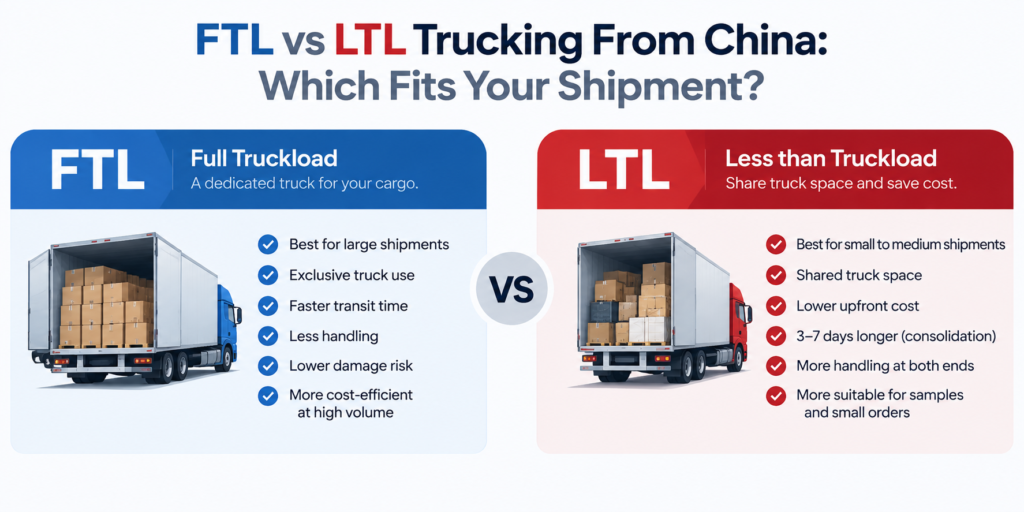
- FTL vs LTL Trucking From China: Which Fits Your Shipment?
What Is FTL Trucking?
FTL means Full Truckload. Your cargo takes the entire vehicle — nobody else’s goods travel with it. The truck loads once at your supplier’s facility and doesn’t open again until it reaches the delivery address.
This is the right choice for large volumes, high-value goods, or anything that benefits from minimal handling — furniture, machinery, palletised electronics, or fragile items that shouldn’t be reloaded partway through the journey.
What Is LTL Trucking?
LTL means Less Than Truckload. Your cargo shares space with other shipments going in a similar direction, and the carrier consolidates several loads into one truck.
You pay for the space you use rather than the whole vehicle, which brings the cost down substantially for smaller shipments. The trade-off is added time — your goods may sit at a consolidation point until the truck fills, and they’re handled more times along the route.
FTL vs LTL: Side-by-Side
Feature | FTL (Full Truckload) | LTL (Less Than Truckload) |
Cost | Higher total, but efficient at volume | Lower for small shipments |
Speed | Faster, direct routing | Slower — waits for consolidation |
Handling | Minimal — loaded once | More — moved through hubs |
Best for | Large, heavy, high-value cargo | Small or partial loads |
Scheduling | Dedicated departure | Shared, less predictable |
Damage risk | Lower | Slightly higher |
Choose FTL if: you’re shipping a large volume, high-value or time-sensitive cargo, or anything that shouldn’t be reloaded between trucks.
Choose LTL if: your shipment is small, cost matters more than a few extra days, and you can accept shared handling.
If you’re unsure which fits, send your cargo details — the right answer depends on how close your volume sits to filling a standard truck.
How Long Does Road Freight Take From China?
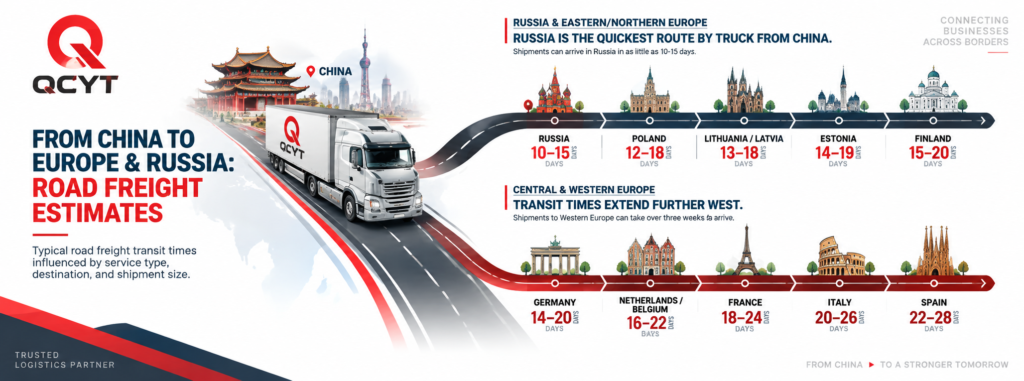
Transit Times to Europe & Russia
Destination | Transit Time |
Russia | 10–15 days |
Lithuania | 13–18 days |
Latvia | 13–18 days |
Poland | 12–18 days |
Estonia | 14–19 days |
Germany | 14–20 days |
Czech Republic | 15–20 days |
Finland | 15–20 days |
Netherlands | 16–22 days |
Belgium | 16–22 days |
Sweden | 17–23 days |
France | 18–24 days |
Italy | 20–26 days |
Spain | 22–28 days |
Transit Times to Central Asia & Iran
Destination | Transit Time |
Kyrgyzstan | 2–5 days |
Kazakhstan | 3–7 days |
Uzbekistan | 5–10 days |
Tajikistan | 5–9 days |
Turkmenistan | 7–12 days |
Iran | 7–12 days |
The pattern to notice: Eastern European and Central Asian destinations move faster because the routes are more direct and cross fewer borders. Western Europe takes longer because the truck passes through multiple customs zones — each one adding processing time that has nothing to do with distance alone.
What Actually Adds Time on the Road
Border crossings. Each border means a customs check, and congestion at any single crossing point delays the whole truck, not just your shipment.
LTL consolidation. Add several days at origin while the carrier fills the remaining truck space, and potentially more at destination during deconsolidation.
Winter conditions. Mountain passes and northern routes can slow significantly in winter months — build in buffer time for shipments moving November through February.
Documentation gaps. A missing or incorrect customs document at one border can hold the entire truck, not just your pallets, since most trucking documentation covers the whole load.
Road freight gives you more flexibility than sea or rail when your final delivery point is far from a port or rail terminal - the truck can go directly to your warehouse door.
💡 PRO TIP
Major Road Freight Routes From China
Road freight from China runs on a handful of established overland corridors, each connecting different regions with different border arrangements and drive times.
- Silk Road Economic Belt (SREB) — China through Kazakhstan, Kyrgyzstan, Uzbekistan, Turkmenistan and Iran into Europe.
- New Eurasian Land Bridge (NELB) — China through Kazakhstan and Russia to Belarus, then onward into Europe. Generally the fastest overland path toward Russia and the EU.
- China–Central Asia Road Corridor — China through Kazakhstan, Kyrgyzstan, Uzbekistan, Tajikistan and Turkmenistan toward West Asia.
- China–Mongolia–Russia Corridor (CMREC) — China through Mongolia into Russia and onward toward Europe.
- China–Pakistan Economic Corridor (CPEC) — China to Pakistan, connecting to the Arabian Sea via Gwadar Port.
- China–Indochina Peninsula Corridor — China to Vietnam, Laos, Cambodia, Thailand and Myanmar.
- Trans-Asian Highway Network (TAH) — the broader network linking China with Central, South and Southeast Asia and extending toward Europe and the Middle East.
Central Asian corridors tend to be more direct and predictable for shorter overland runs. Corridors reaching into Europe cover more distance and cross more borders, which is the main driver behind longer transit times and higher rates on those routes.
Route selection isn’t only about geography — it affects border handling patterns and how much buffer time you should plan around a delivery date. QCYT selects the corridor based on your specific destination rather than defaulting to one standard route for every shipment.
Documents Needed for Road Freight From China
Cross-border trucking involves customs clearance at every border the truck crosses, which makes documentation accuracy even more important than in single-clearance modes like ocean or air freight.
Commercial invoice and packing list. The same core documents used in any international shipment — accurate product description, value, quantity and carton details.
CMR consignment note. The standard road transport document used across most Eurasian trucking corridors, functioning similarly to a bill of lading for sea freight.
Certificate of origin. Frequently required at borders and for preferential duty treatment under regional trade agreements.
TIR carnet (where applicable). Used on many China–Europe and China–Central Asia corridors to simplify customs at multiple border crossings under one transit document, rather than clearing separately at each one.
Product-specific certificates. Depending on your goods and destination — CE marking for the EU, technical regulation certificates for the Eurasian Economic Union (Russia, Kazakhstan, Kyrgyzstan), and similar.
Missing or incorrect paperwork at any single border can hold the entire truck. Send your invoice and packing list for review before pickup, not after the truck has already crossed the first border.
Why Choose QCYT for Road Freight Service?
Route Selection Based on Your Destination
Rather than defaulting to one corridor, QCYT selects the route that gives the best balance of transit time and cost for your specific destination — Central Asia, Russia, or Western Europe each favour different corridors.
FTL and LTL Under One Service
Whether your cargo fills a full truck or needs shared space, the same coordinator handles booking, documentation and tracking.
Cross-Border Documentation Handled
CMR notes, TIR carnets and certificates of origin are prepared and checked before the truck departs, reducing the risk of a hold at any of the multiple borders these routes cross.
DDP Available on Many Routes
On many corridors, road freight can be arranged as door-to-door with duties paid — pickup from your supplier, export handling, transit, customs clearance at destination, and final delivery to your address, all under one invoice. Availability depends on the destination and commodity; QCYT will confirm this before booking.
Your Questions Answered
How is road freight cost calculated from China?
Cost depends on whether you book FTL or LTL, your cargo’s weight and volume, the distance to your destination, and route conditions like border handling and seasonal demand. Longer routes and heavier shipments cost more; LTL can reduce cost for smaller loads.
How long does road freight from China to Europe take?
Generally 10–28 days. Eastern European destinations like Poland or the Baltic states move faster, typically 12–19 days, while Western Europe France, Italy, Spain takes longer, up to 22–28 days, due to distance and multiple border crossings.
Which service is better for heavy or oversized cargo?
FTL. A dedicated truck means your cargo isn’t reloaded or reshuffled at consolidation points, which matters for stability, protection and predictable transit time on heavy or bulky loads.
Does road freight from China support DDP delivery?
On many routes, yes. A DDP road freight service can include pickup in China, export handling, customs clearance at destination, duty payment and final delivery — all on one invoice. Not every route or commodity qualifies; confirm with your forwarder before booking.
Is road freight suitable for fragile or sensitive goods?
Yes, provided the cargo is properly packed and, where possible, booked as FTL. A dedicated truck means fewer handling points and a more stable journey than LTL, where cargo moves through consolidation hubs.
What is the fastest road route from China to Russia?
The New Eurasian Land Bridge (NELB), running through Kazakhstan and Russia toward Belarus and onward to Europe, is generally the most direct overland corridor toward Russia. Actual transit time still depends on your origin city, border conditions and whether the shipment is FTL or LTL.
Why choose road freight over sea freight from China?
Road freight is faster than sea freight and offers more flexible routing, particularly useful when your delivery point is inland and far from a seaport. Sea freight remains cheaper for large, non-urgent cargo, but road freight is the stronger option when timing matters more than the lowest possible cost.
Can shipments be tracked during road transit?
Yes, on both FTL and LTL services, though visibility depends on the carrier and route. Most shipments provide updates at pickup, border crossings, and estimated delivery.
Is road freight cheaper than air freight from China?
Generally, yes often substantially so for larger or heavier shipments. Air freight remains faster, but road freight is the more economical option when you need to control cost without accepting the much longer timelines of ocean freight.
Which countries can be reached by road freight from China?
Common destinations include Russia, Kazakhstan, Kyrgyzstan, Uzbekistan, Tajikistan, Turkmenistan, Poland, Germany, France and Italy, with coverage depending on which corridor serves your specific route.