
Professional sea freight service
See what container shipping from China really costs, compare FCL and LCL options, check sailing times to your port, and get a rate built around your actual cargo, not a generic estimate.
Secure & Reliable
Fast Response
Secure & Reliable
Quote within 30 minutes
FCL & LCL Under One Roof
Whether you have three cartons or three containers, QCYT books the option that costs you less.
Door-to-Door Ocean DDP Available
Duties, taxes, clearance and final delivery handled on one invoice, in one price.
Every Major Chinese Port
Shenzhen, Shanghai, Ningbo, Guangzhou, Qingdao, Xiamen and Tianjin with regular weekly sailings.
Quick Answer: Ocean Freight Cost, Transit Time & Quote
Ocean freight services from China in 2026 typically cost $1,500–$3,000 for a 20ft container and $2,000–$3,500 for a 40ft container, depending on destination. Smaller shipments move as LCL and are priced by volume, usually $60–$280 per CBM. The final number depends on your destination port, cargo volume, container type, sailing season and the carrier’s space situation that week.
If your cargo is small, LCL shipping is almost always the practical choice, because you pay only for the cubic metres you occupy. Once your shipment reaches roughly 13–15 CBM, a full container (FCL) often works out cheaper per unit and gives you faster port handling.
Typical sailing times from China are 5–12 days within Asia, 18–28 days to the Middle East, 25–45 days to Europe, 15–40 days to North America, and 18–30 days to Australia and New Zealand.
To get an accurate ocean freight quote, QCYT needs seven things: pickup city in China, destination port or address, total CBM, gross weight, carton dimensions, product type, and your Incoterm.
Is Ocean Freight the Right Choice for Your Shipment?
Use this decision box before you request a rate. It covers when sea freight makes sense, what it costs, what moves the price, and how to get a quote that won’t change after booking.
Sea Freight From China — Quick Overview & Cost Guide (2026)
🚢 When Ocean Freight Makes Sense
Bulk cargo · Lowest cost per unit
- Best for: Heavy, bulky or non-urgent cargo where landed cost matters more than speed.
- Transit time: 5–12 days within Asia, 15–40 days to North America, 25–45 days to Europe.
- Typical cargo: Furniture, machinery, wholesale stock, e-commerce restocks, building materials, packaging, plastics, textiles.
- Choose this if: You can plan 5–8 weeks ahead and want the cheapest freight cost per unit.
📦 What Moves Your Final Price
CBM · Container type · Route conditions
- Main drivers: Volume, gross weight, destination port, pickup city, container type, sailing route and port congestion.
- FCL or LCL: LCL suits small cargo; FCL usually wins above 13–15 CBM.
- CBM formula: Length × Width × Height in metres. More volume means a higher LCL bill.
- Choose this if: Your order quantity or destination is still flexible and you want to optimise before booking.
💵 What Ocean Freight Costs
FCL container rates · LCL per CBM · 2026 guide
- 20ft container: Roughly $1,500–$3,000 depending on destination region.
- 40ft container: Roughly $2,000–$3,500 by route, container type and season.
- LCL: Charged by volume, usually $60–$280 per CBM, with a minimum charge of 1 CBM on most lanes.
- Choose this if: You want to compare real container shipping costs before committing to an order.
✅ How to Get a Tighter Quote
Fewer surprises · Fewer revisions
- Send us: Pickup city, destination, carton dimensions, total CBM, gross weight, product description and HS code.
- Helpful extras: Packing list, proforma invoice, Incoterm, preferred container size, delivery address type.
- Cut your cost: Redesign oversized cartons, consolidate two suppliers into one booking, book outside peak weeks, and check FCL against LCL at the margin.
- Choose this if: You want a route-specific rate instead of a market average.
Need current ocean freight rates from China? Send your cargo details and we’ll check the best FCL or LCL option for your route.
Introduction
Ocean freight moves the overwhelming majority of goods leaving China, and for good reason. Nothing else comes close on cost per kilo once your shipment gets large. The trade-off is time and complexity.
That complexity is where importers lose money. A quote that looks $300 cheaper can end up $800 more expensive after destination charges, and a shipment that “should” take 30 days can take 45 if the routing goes through a congested transhipment port.
This page explains how ocean freight pricing actually works in 2026 — container rates by region, LCL pricing by CBM, how to calculate your own volume, realistic sailing times, and which documents you need in hand before your cargo leaves the factory.
QCYT Shipping handles ocean freight services from every major Chinese port, with FCL, LCL and full door-to-door delivery to more than 180 countries.
Table of Contents
- You might also need these services!


DDP Shipping from China

Express courier from China
How Much Do Ocean Freight Services From China Cost?
The tables below show typical price ranges by container type and destination region. Use them for budgeting and for sanity-checking quotes you receive elsewhere.
An honest caveat before you read them: ocean freight is a live market. Rates move weekly with vessel capacity, fuel cost, Red Sea and canal routing decisions, and seasonal demand. These ranges reflect normal market conditions and can shift outside them quickly. Always confirm with a live quote before you commit to a purchase order.
20ft Container Shipping Cost From China (Estimates)
| Region | Example Destinations | Estimated Cost |
|---|---|---|
|
Middle East |
UAE, Saudi Arabia, Qatar, Kuwait, Oman |
$1,500–$2,100 |
|
North America |
USA, Canada, Mexico |
$2,000–$2,800 |
|
South America |
Brazil, Chile, Peru, Colombia, Argentina |
$2,100–$3,000 |
|
Europe |
Germany, UK, France, Netherlands, Italy |
$1,800–$2,600 |
|
Asia |
Japan, South Korea, Vietnam, Thailand, Malaysia, India, Pakistan. |
$1,500–$2,100 |
|
Africa |
Egypt, South Africa, Kenya, Nigeria, Morocco |
$1,900–$2,700 |
|
Oceania |
Australia, New Zealand, Fiji |
$1,700–$2,400 |
40ft Container Shipping Cost From China (Estimates)
| Region | Example Destinations | Estimated Cost |
|---|---|---|
|
Middle East |
UAE, Saudi Arabia, Qatar, Kuwait, Oman |
$2,100–$2,800 |
|
North America |
USA, Canada, Mexico |
$2,500–$3,400 |
|
South America |
Brazil, Chile, Peru, Colombia, Argentina |
$2,600–$3,500 |
|
Europe |
Germany, UK, France, Netherlands, Italy |
$2,300–$3,200 |
|
Asia |
Japan, South Korea, Vietnam, Thailand, Malaysia, India, Pakistan. |
$2,000–$2,600 |
|
Africa |
Egypt, South Africa, Kenya, Nigeria, Morocco |
$2,400–$3,300 |
|
Oceania |
Australia, New Zealand, Fiji |
$2,200–$3,000 |
Notice something important here: a 40ft container is not double the price of a 20ft, but it holds roughly twice the volume. If your cargo is light and bulky, a 40ft or 40ft High Cube is usually the better value even when a 20ft would technically fit your goods.
LCL Shipping Rates per CBM From China (Estimates)
| Region | Example Destinations | Cost per CBM |
|---|---|---|
|
Middle East |
UAE, Saudi Arabia, Qatar, Kuwait, Oman |
$80–$150 |
|
North America |
USA, Canada, Mexico |
$120–$280 |
|
South America |
Brazil, Chile, Peru, Colombia, Argentina |
$140–$260 |
|
Europe |
Germany, UK, France, Netherlands, Italy |
$90–$160 |
|
Asia |
Japan, South Korea, Vietnam, Thailand, Malaysia, India, Pakistan. |
$60–$120 |
|
Africa |
Egypt, South Africa, Kenya, Nigeria, Morocco |
$100–$180 |
|
Oceania |
Australia, New Zealand, Fiji |
$90–$170 |
What Is Not Included in These Numbers
This is where most quote comparisons go wrong. The figures above are ocean freight only. A realistic landed cost also includes:
- Origin charges — export clearance, terminal handling at the Chinese port, documentation, and inland trucking from your supplier to the port.
- Destination charges — terminal handling, delivery order fee, and possible demurrage or detention if you clear late.
- Customs — brokerage fee, import duty and VAT or GST in your country.
- Final delivery — trucking from the arrival port to your warehouse, plus unloading.
When you compare two forwarders, always ask whether the rate is port-to-port, door-to-port, or door-to-door. Comparing a port-to-port rate against a door-to-door rate is how importers end up choosing the more expensive option by mistake.
Ask every forwarder for a written "all-in to my door" figure. If they cannot give you one, they do not control the destination side of the shipment — and that is where surprise invoices come from.
💡 PRO TIP
FCL vs LCL Shipping From China
What Is FCL Shipping?
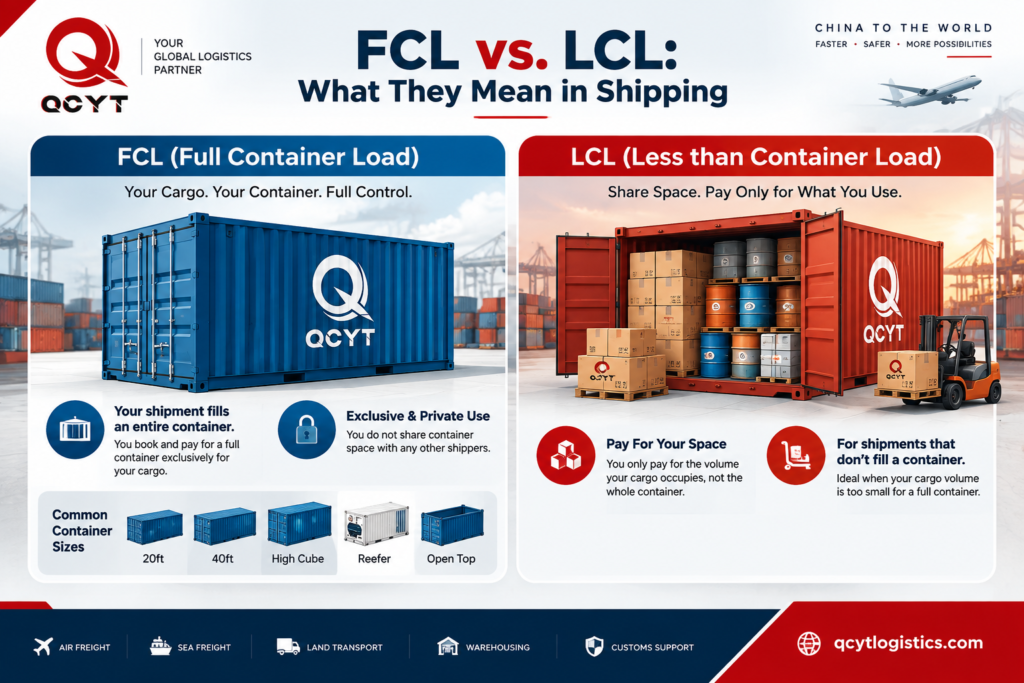
FCL means Full Container Load. You book an entire container for your cargo alone. Nobody else’s goods go inside it.
You can choose the equipment that fits your product: 20ft standard, 40ft standard, 40ft High Cube for extra height, 45ft High Cube, reefer for temperature-controlled goods, or open top and flat rack for cargo that will not fit through the doors.
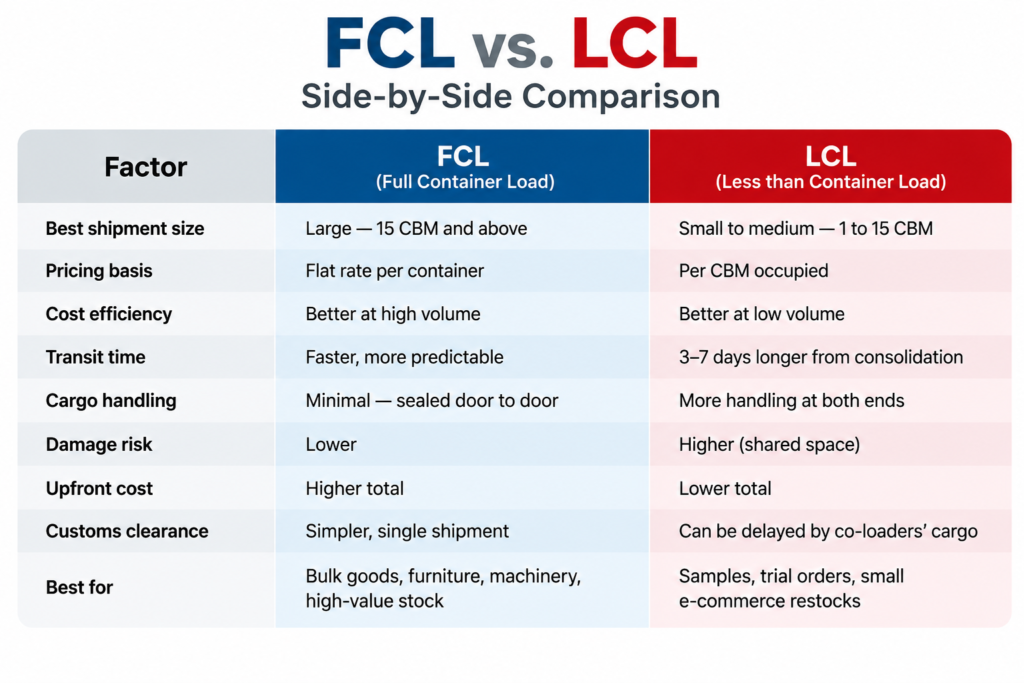
Because the box is sealed at your supplier’s factory and not opened again until it reaches you, FCL means less handling, lower damage risk, faster port processing and more predictable arrival dates.
What Is LCL Shipping?
LCL means Less than Container Load. Your cargo shares a container with other importers’ shipments.
You pay for the volume you occupy, measured in CBM, so a three-cubic-metre shipment costs a fraction of a full container. This is what makes ocean freight accessible to smaller sellers.
The trade-off is handling. Your goods are consolidated into the container at origin and deconsolidated at destination, which adds a few days at each end and means your cartons get moved by more hands. Pack accordingly – LCL cargo needs sturdier cartons than FCL cargo.
- FCL vs LCL Side-by-Side Comparison
The Break-Even Point Nobody Explains Properly
The common advice is “switch to FCL around 13–15 CBM.” That is a fair rule of thumb, but the real break-even depends on your lane.
Do this instead. Take the 20ft container rate for your destination and divide it by 28 (the usable CBM inside a 20ft box). That gives your effective cost per CBM if you filled it. Compare that to the LCL rate you were quoted.
Example: a 20ft to the UAE at $1,800 ÷ 28 = about $64 per CBM. If your LCL quote is $110 per CBM, then at 16 CBM you would pay $1,760 for LCL — essentially the same as a full container, but with more handling and a slower transit. At that point, FCL is clearly better.
Run this calculation before every large order. It takes thirty seconds and regularly saves several hundred dollars.
If you are close to the break-even line, ask your supplier whether they can add stock to the order. Filling a container you are already paying for is the cheapest inventory you will ever buy.
💡 PRO TIP
What Is CBM in Ocean Freight?
CBM stands for cubic metre. It measures the volume your cargo occupies, and in LCL shipping it is the single number that determines your price.
The logic of sea freight is simple: you are buying space, not weight. A container has a fixed volume, and the carrier sells that volume. Whether your cartons are full of feathers or full of bolts matters far less than how much room they take.
There is one exception. On most LCL services, the carrier charges on whichever is higher: your CBM, or your weight in tonnes. This is called the weight/measurement rule (W/M). If your cargo weighs more than one tonne per cubic metre – dense goods like ceramics, liquids, metal parts or stone – you will be charged on weight instead of volume. Most general merchandise never hits this threshold, but it catches importers of heavy goods off guard.
How to Calculate CBM for Ocean Freight
The formula is:
CBM = Length × Width × Height (all in metres)
Measure the outside of the carton, not the product inside. Round dimensions up to the nearest centimetre. Carriers measure the largest point of the carton, including any bulge, so a tightly packed box measures smaller than a stuffed one.
Worked Example: Stainless Steel Kitchen Racks
You are shipping 120 cartons of kitchen racks from Ningbo to Rotterdam.
Carton dimensions:
- Length: 0.80 m
- Width: 0.45 m
- Height: 0.30 m
Gross weight: 14 kg per carton
Step 1 — CBM per carton
0.80 × 0.45 × 0.30 = 0.108 CBM
Step 2 — Total volume
120 × 0.108 = 12.96 CBM
Step 3 — Check the weight rule
120 × 14 kg = 1,680 kg = 1.68 tonnes
Volume (12.96) is higher than weight in tonnes (1.68), so you are charged on volume.
Step 4 — Estimate the LCL cost
12.96 CBM × $120 per CBM ≈ $1,555, before origin and destination charges.
Step 5 — Compare against FCL
A 20ft to Rotterdam at around $1,900, divided by 28 CBM, is about $68 per CBM. At 12.96 CBM you are sitting right at the break-even. Adding 15% more stock would make the full container the better buy.
This is exactly the kind of check QCYT runs before quoting, rather than simply pricing whichever option you asked for.
How Long Does Ocean Freight Take From China?
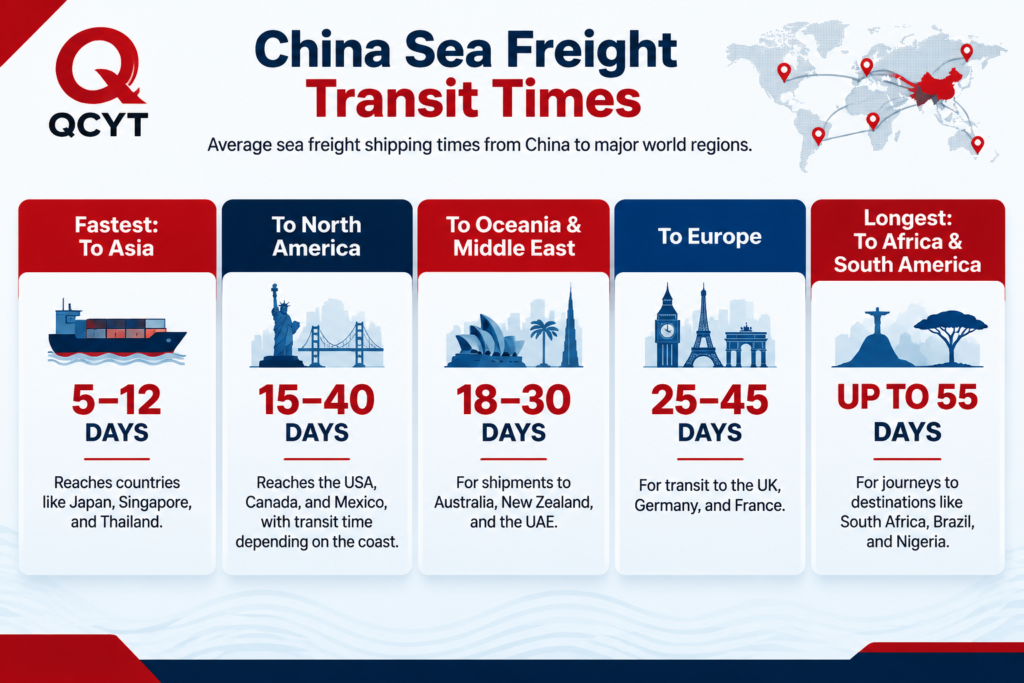
Sailing times depend on the destination port, whether the service is direct or transhipped, and current port conditions. The ranges below reflect realistic door-to-port timing for standard routings.
Why the Ranges Are So Wide
Direct vs transhipment. A direct sailing goes port to port. A transhipped routing unloads your container at a hub like Singapore, Busan or Colombo and waits for a connecting vessel. Transhipment typically adds 7–14 days, and it is often invisible in a quote unless you ask.
Coast matters more than country. China to Los Angeles can be 15–20 days. China to New York via the Panama Canal can be 30–38 days. “Shipping to the USA” is not one transit time.
Port congestion. A backed-up destination port can add a week of waiting at anchor before berthing. This is unpredictable and no forwarder can promise it away.
LCL consolidation time. Add 3–7 days at each end for LCL, since the container has to fill before it sails and be unpacked on arrival.
Chinese New Year. Factories close for two to three weeks, and the four weeks before the holiday see a booking rush that pushes rates up and delays cutoffs. If your goods need to land in Q1, book before mid-January.
Total Time vs Sailing Time
Sailing time is only part of the story. A realistic plan looks like this:
- Production at your supplier: 15–30 days
- Inland trucking to the port and export clearance: 3–5 days
- Waiting for the vessel cutoff: 2–7 days
- Ocean transit: as per the table above
- Import clearance at destination: 2–5 days
- Final delivery to your warehouse: 1–4 days
For a typical Europe shipment, that is 8 to 12 weeks from placing the order to receiving the stock. Plan your reorder points around the full cycle, not the sailing time.
Documents Required for Ocean Freight From China
Paperwork causes more delays than weather, congestion and equipment shortages combined and it is the one factor entirely within your control.
The Core Documents
- Commercial Invoice. Issued by your supplier. It must show the seller and buyer, a clear product description, quantity, unit price, total value, currency and Incoterm. The value here must match what you actually paid, or customs will query it.
- Packing List. Carton count, dimensions of each carton type, net and gross weight, and total CBM. This is what your forwarder uses to book space and what customs uses to verify the shipment.
- Bill of Lading (B/L). The carrier’s document, issued after the vessel sails. It is the title to your goods — without the correct B/L, you cannot collect the cargo. Choose between an original B/L (secure, but must be couriered) and a Telex Release or Sea Waybill (faster, common when you trust the supplier).
- Incoterms Agreement. Not a separate form, but it must be stated on the invoice. FOB, EXW, CIF and DDP allocate cost and risk very differently. Getting this wrong is the most expensive documentation mistake importers make.
Documents That Depend on Your Product
Certificate of Origin. Proves the goods were made in China. Required in many countries, and essential if you want a reduced duty rate under a free trade agreement — for example the ASEAN–China FTA or RCEP.
MSDS or Dangerous Goods Declaration. Needed for batteries, chemicals, aerosols, paints, magnets and anything flammable.
Fumigation Certificate. Required by Australia, New Zealand and several other countries when wooden pallets or crates are used. Alternatively, use ISPM 15 heat-treated pallets and provide the stamp.
Product Certificates. CE for Europe, FCC for the USA, SASO for Saudi Arabia, and similar. These are usually needed at import clearance, not export — but arrange them before you ship, not after the container arrives.
A Practical Habit Worth Building
Ask your supplier for draft copies of the invoice and packing list before the cargo leaves the factory. Send them to your forwarder for a check. A ten-minute review at that stage prevents most customs holds, and amending a document before shipping costs nothing — amending a B/L after sailing costs money and time.
Why Choose QCYT for Ocean Freight Services?
Why Choose QCYT for Ocean Freight Services?
Booking a container is the easy part. What separates forwarders is what happens when a sailing is cancelled, a document is wrong, or customs asks a question you cannot answer.
Coverage Across Every Major Chinese Port
QCYT arranges ocean freight from Shenzhen, Shanghai, Ningbo, Guangzhou, Qingdao, Xiamen and Tianjin, plus inland collection from manufacturing regions such as Yiwu, Dongguan, Foshan and Zhongshan. That means we can route your cargo through whichever port gives the best schedule and rate for your destination, rather than defaulting to the one nearest the factory.
FCL, LCL and Ocean DDP
Whether you need a single container, three cubic metres of shared space, or a fully managed door-to-door service with duties paid, the same team handles it. With Ocean DDP, you receive one all-inclusive price covering pickup, export clearance, ocean freight, import clearance, duty, tax and final delivery — including to Amazon FBA and other fulfilment centres.
Two honest limitations: DDP is not available for every commodity or every country, and some regulated products must be imported under your own registration. We will tell you upfront if your goods fall outside what DDP can cover.
Documentation Reviewed Before Departure
Every shipment’s invoice, packing list and HS classification is checked before the cargo is booked. This is unglamorous work, and it is the single biggest reason shipments arrive on schedule.
One Point of Contact
You deal with the same coordinator from quote to delivery. No ticket queue, no handover between departments, and a response within 30 minutes during business hours.
Your Questions Answered
How long does ocean freight take from China?
Between 5 and 55 days depending on destination. Asia is typically 5–12 days, the Middle East 18–28 days, Europe 25–45 days, North America 15–40 days depending on coast, and Africa or South America 30–55 days. Add 3–7 days at each end for LCL consolidation, and expect longer transits during Chinese New Year and peak season.
How much does it cost to ship a container from China?
A 20ft container generally falls between $1,500 and $3,000 under normal market conditions, and a 40ft between $2,000 and $3,500. The price is driven by destination, container size, sailing season, routing and current carrier capacity. These figures cover ocean freight only origin charges, destination handling, customs duty and final delivery are additional.
What is the difference between FCL and LCL shipping?
With FCL you book an entire container for your cargo alone, sealed at origin and opened at destination. With LCL your cargo shares a container with other shipments and you pay only for the volume you use. FCL is faster and safer; LCL is cheaper for small shipments.
When should I switch from LCL to FCL?
Generally around 13–15 CBM, but check your specific lane. Divide the 20ft container rate for your destination by 28 usable CBM, then compare that figure to your quoted LCL rate per CBM. When LCL costs more in total than a full container, switch.
How much does LCL shipping cost per CBM from China?
Most lanes fall between $60 and $280 per CBM. Short Asian routes sit at the lower end; North America and long-haul destinations at the higher end. Nearly all LCL services apply a one-CBM minimum charge, so a 0.4 CBM shipment is billed as 1 CBM.
What is CBM and how do I calculate it?
CBM is cubic metres the volume of your cargo. Measure each carton’s outside length, width and height in metres, multiply the three together, then multiply by the number of cartons. A 0.8 × 0.45 × 0.3 m carton is 0.108 CBM; 120 of them is 12.96 CBM.
Which container sizes are available from China?
20ft standard, 40ft standard, 40ft High Cube, 45ft High Cube, reefer (temperature-controlled), open top and flat rack. A 20ft holds roughly 28 usable CBM and a 40ft roughly 58. The High Cube adds about 30 cm of internal height, which is useful for light, tall cargo.
Do I need cargo insurance for ocean freight?
It is optional but strongly recommended. Standard carrier liability is capped at a very low figure per package under international convention nowhere near the value of most commercial cargo. All-risk marine insurance typically costs a small percentage of the cargo value and covers loss, damage and general average.
What documents do I need to ship by sea from China?
At minimum: a commercial invoice, packing list, bill of lading and a clearly stated Incoterm. Depending on your product and destination you may also need a certificate of origin, MSDS or dangerous goods declaration, fumigation certificate, and product compliance certificates.
How can I reduce my ocean freight cost from China?
Redesign oversized cartons to cut CBM, consolidate orders from multiple suppliers into one booking, compare FCL against LCL at the margin, avoid the four weeks before Chinese New Year, negotiate FOB terms with your supplier so you control the freight, and give your forwarder accurate measurements so the quote does not get revised upward later.